Tierra del Fuego National Park
natural beauty of Patagonia
Located in the far south of Argentina, this park offers a unique experience where mountain peaks meet the ocean, creating breathtaking landscapes. With a diversity of ecosystems ranging from subantarctic forests to peat bogs and rocky coastlines, Tierra del Fuego National Park is home to a rich variety of flora and fauna, including iconic species such as the beaver, the Andean condor, and the guanaco.
Venture along its well-marked trails and discover crystal-clear waterfalls, glacial lakes, and panoramic viewpoints that allow you to contemplate the immensity of nature in its purest form. Adventurers can embark on kayaking excursions through the park's waterways or trek to the mythical End of the World, an experience that will be etched in your memory forever.
Turn your visit to Tierra del Fuego National Park into an unforgettable adventure and discover why it's considered one of Argentina's most precious natural treasures. Don't wait any longer to explore this paradise at the end of the world!
The Forest of Tierra del Fuego National Park
The forest of Tierra del Fuego National Park is a spectacle of nature at its most majestic. Located in the southernmost part of Argentina, this subantarctic forest captivates with its lush vegetation and unique biodiversity. Venturing into this forest, one is immersed in a world of vibrant colors and fresh aromas, where trees reach majestically toward the sky and light filters through the dense canopies.
The dominant trees in this forest are the lenga and the ñire, which create a green canopy that stretches as far as the eye can see. Beneath their shade, a variety of shrubs, mosses, and lichens form a carpet of vegetation that covers the ground, providing shelter and food for numerous species of wildlife.
Well-marked trails allow visitors to explore this unique natural environment, offering the chance to discover hidden waterfalls, crystal-clear streams, and glacial lakes of unparalleled beauty. Furthermore, the Tierra del Fuego National Park's forest is home to a diverse array of wildlife, including birds such as the Magellanic woodpecker, Andean condor, and petrel, as well as mammals like the red fox and beaver, among others.
In summary, the Tierra del Fuego National Park forest is a biodiversity sanctuary and a natural treasure that deserves to be explored and admired by all those who seek to connect with the beauty and tranquility of nature in its purest state.
Flora and Fauna
Ecosystem:
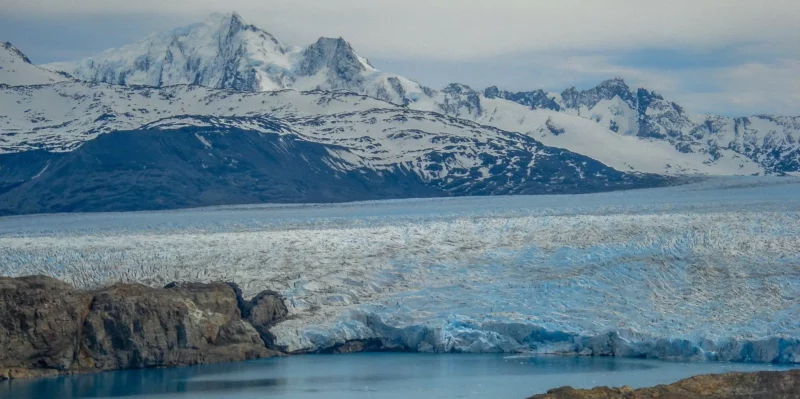
Tierra del Fuego National Park is located in the Patagonian Forest ecoregion, making it Argentina's southernmost protected area. Here, the foothills of the Andes Mountains decrease in altitude and meet the sea at the Beagle Channel, creating a unique landscape that includes coastline, lakes, valleys, peat bogs, and magnificent forests.
Flora:
The park's forests are primarily composed of lenga trees, which give the landscape a distinctive, deep reddish hue during autumn. In wetter areas, they are interspersed with guindo and canelo trees. Ñire trees grow along the edges of the peat bogs. Magellanic colihue is also common throughout the park. Additionally, lichens known as "old man's beard" are frequently found hanging from tree branches. Throughout the year, one can admire the flowers of species such as the notro, with its striking red blossoms, mutillas, and yellow-violet flowers.
Fauna:
As for the fauna, the park is home to a variety of mammals, including the guanaco, the huillín, the Fuegian red fox (exclusive to the island), the gray fox, the marine otter and the beaver, the latter being an introduced species.
The park's birdlife is remarkably rich due to the meeting point of land and sea. Along the coast, species such as the kelp geese, the kelp geese (the national park's symbol), the black-browed albatross, the southern steamer duck, oystercatchers, gulls, and grebes can be found. In the forests and surrounding areas, species such as the austral parakeet, the Magellanic woodpecker, the thorn-tailed rayadito, the upland goose, the Austral parakeet, and the Austral thrush can be observed.
The rocks along the Beagle Channel coast are teeming with marine invertebrates such as mussels, clams, limpets, snails, and crustaceans like king crabs. Native fish species include the Puyén, the peladilla, and the snook.
The Train at the End of the World
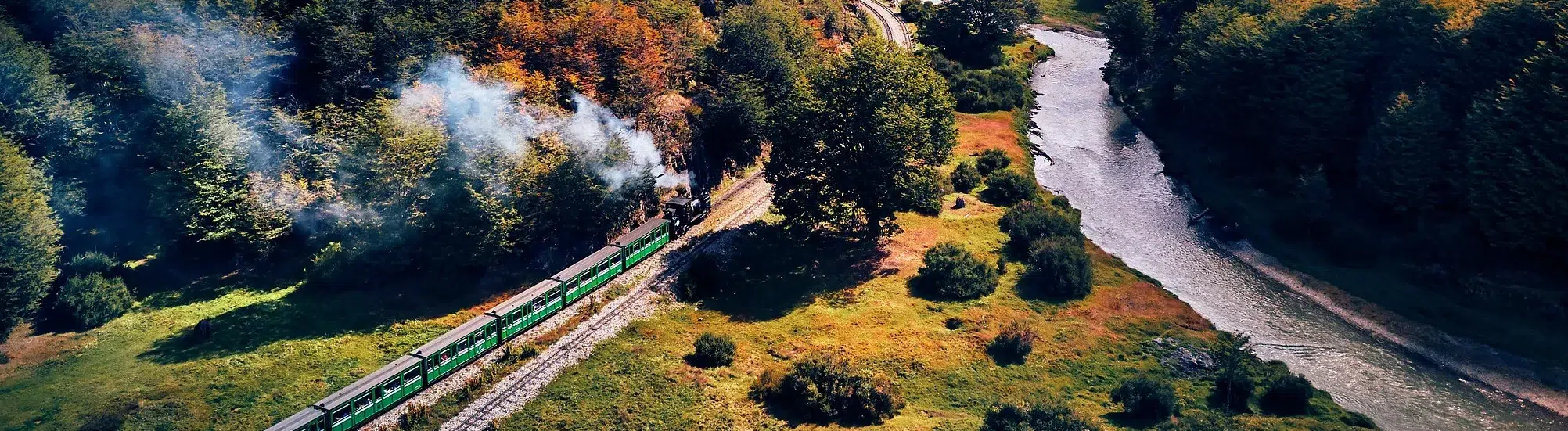
The End of the World Train is the southernmost operating railway on the planet. It travels the last few kilometers of the old route that for decades transported prisoners from the Ushuaia prison to the forests surrounding the city, where they worked extracting firewood. Today, restored as a narrow-gauge tourist railway, it enters Tierra del Fuego National Park, crossing the Cañadón del Toro canyon, the Bosque de las Hachas (Forest of the Axes), and skirting the Pipo River until reaching the National Park Station.
The tour lasts approximately 1 hour and 50 minutes (round trip) and includes a stop at La Macarena Waterfall, where you can go down and up to a viewpoint with panoramic views of the valley. The train service is not part of our tours: it is booked directly with the official operator.
Visit the official website of the train
Reservations, schedules and fares on the official operator's website.
Entrance to the National Park
Access to Tierra del Fuego National Park requires an entrance fee, which can be purchased online through the official system of the National Parks Administration (APN). We recommend purchasing your ticket in advance to expedite entry at the control booth. Entrance fees vary depending on whether you are an Argentine resident, a resident of Tierra del Fuego, or a foreign visitor, and there are reduced rates for children and seniors.
On all our excursions to the park, the entrance fee is explained separately so that each visitor can arrange it with the corresponding rate.
Buy park admission
Official system of the National Parks Administration.
Our excursions to the National Park
Explore Tierra del Fuego National Park with local guides. You have three options depending on the type of experience you're looking for: the classic half-day tour of the main trails and viewpoints, a version that combines the park with a canoe trip down the Lapataia River, or a night trek to Mount Susana with sunset over the Beagle Channel.
Tierra del Fuego National Park
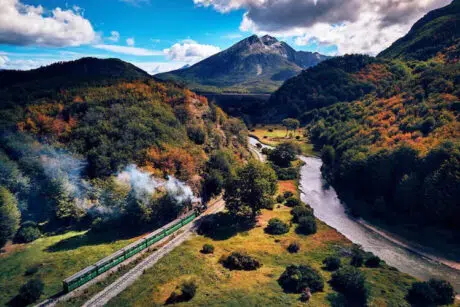
Explore Tierra del Fuego National Park from Ushuaia. Forests, lakes, and the End of the World Train on a unique half-day tour.
National Park and Canoes
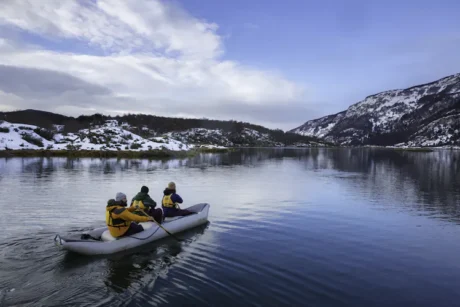
Discover Tierra del Fuego National Park with walks through forests and a canoe trip through pure waters surrounded by untouched nature.

Night Trekking Mount Susana
Experience a night trek through forests and mountains, with sunset over the Beagle Channel and starry skies in the heart of Patagonia.